
Menu

HUPR and Motion Capture Advancing the Circus Arts
Technological innovation meets acrobatic virtuosity. The studios at the National Circus School are currently transforming into genuine research laboratories, driven by the innovative work of the Center for Research on Human Potential (HUPR). At the heart of this project: three-dimensional motion capture testing that could redefine education and creative expression within the circus industry.
 A High-Tech Laboratory in Our Studios
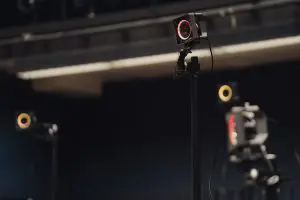
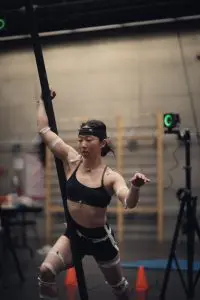
True to its mission of pushing the boundaries of the circus arts, the National Circus School is collaborating closely with the HUPR Center to evaluate new technological tools. The center recently acquired Captury, a cutting-edge system featuring multiple cameras capable of rendering a person’s movements in 3D without requiring physical markers on the artists’ bodies.
The primary objective of this testing phase is to rigorously evaluate the precision and limitations of this new system. To achieve this, data collected by Captury is directly compared with data from OptiTrack, a marker-based motion capture system globally recognized as the industry’s gold standard.
Artists at the Heart of Innovation
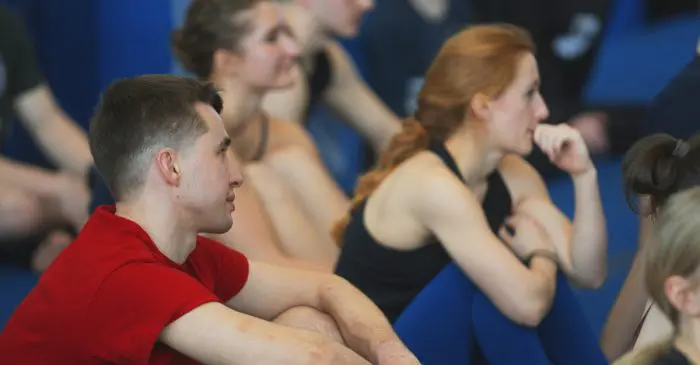
These experiments would not be possible without the active participation of the School’s community. Currently, artists from eight different circus disciplines are taking part. Whether they are current students, graduating seniors, or alumni, their involvement allows the technology to be tested on a wide variety of complex movements specific to the circus arts, ranging from aerial acrobatics to balancing acts.
Revolutionary Applications for the Future of the Circus 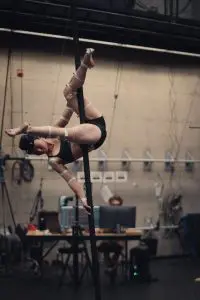
The results of these tests will determine the system’s level of precision and, consequently, its future applications within the School. The envisioned possibilities are vast and promising for the entire sector:
The acquisition of the OptiTrack and Captury systems was made possible by the financial support of the Natural Sciences and Engineering Research Council of Canada (NSERC). Through this initiative, the National Circus School reaffirms its position as an international leader, not only in training the next generation of artists but also in research and technological development within the performing arts.